The Sales Objection Hiding in 27 European Sales Calls
A messaging line that converts extremely well in one market can quietly miss what buyers need in another.
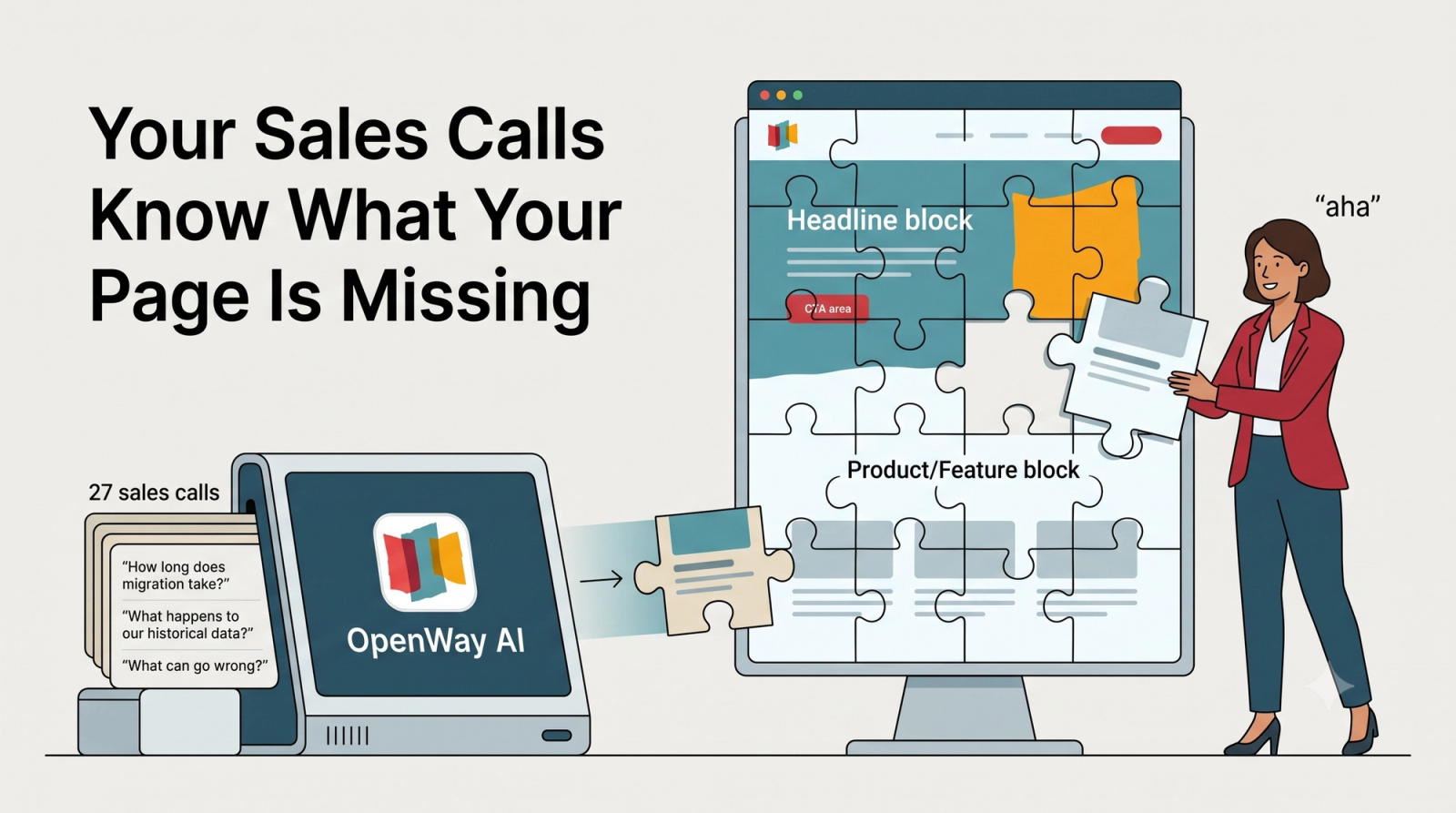
The gap often shows up first in sales calls, long before it makes its way into a marketing report. Sometimes the best conversion research a company has is already sitting inside those conversations. It just needs to be connected to the page, the CRM, and the company's own history to become visible.
Here's how that played out with one of our clients, a B2B SaaS company based in Amsterdam doing roughly $7M ARR.
Their product helps companies manage field and distributed teams: scheduling work, tracking task completion, and collecting data from job sites.
We're not naming them, at their request, but the numbers below are real.
How success in one market hid a problem in another
The company started in Benelux, then expanded into Germany and Spain.
Over time, Latin America became one of its strongest regions, particularly Mexico, Colombia, and Chile, helped by a network of local partners.
Its sales organization was split between Europe and Latin America. That meant the same weekly product discussions sometimes contained feedback from two very different buyer environments without anyone treating them as separate messaging problems.
Marketing had been shaping its European acquisition page using analytics, CRM conversion data, and lessons from the company's strongest regions.
By then, the company was more established in Latin America, and its sales team had become very good at explaining onboarding. Messaging there leaned heavily on ease of use, speed, and convenience for field teams.
Europe told a different story.
New customers were often migrating from legacy software, spreadsheets, or internal systems.
Their hesitation was not primarily about learning the interface.
It was about the transition itself:
- What happens to historical data?
- How long will migration take?
- What happens to ongoing work while the switch is happening?
- What can go wrong?
Sales reps heard versions of those questions regularly. But each rep saw only their part of the pipeline, while weekly meetings naturally focused on larger issues such as pricing, integrations, and enterprise opportunities.
What the Head of Marketing asked for
The request was direct:
"Look at the recent sales calls and tell me if there's something repeating that isn't on our page at all."
What OpenWay AI found across 27 calls
OpenWay AI reviewed 27 recent sales calls from the European pipeline over the previous five weeks.
It cross-referenced those conversations against:
- the current European landing page;
- CRM stage data;
- recorded reasons for stalled deals;
- follow-up emails after the calls;
- sales content the team was already using.
The gap was simple once the conversations were viewed together.
The page emphasized ease of use.
But in 11 of the 27 calls, prospects raised some version of a different question:
How long does migration actually take, and what could go wrong?
Some prospects raised the concern again in follow-up emails even after sales had already addressed it during the call.
That was the stronger signal.
The verbal explanation alone clearly was not resolving the concern. Prospects still needed something more concrete they could refer back to after the conversation.
What OpenWay AI built
OpenWay AI identified migration risk as a recurring objection and pulled the language directly from the way prospects had described it.
It then looked through the company's existing history for examples of completed migrations.
Using that context, OpenWay AI drafted a new version of the European landing page with:
- a clearer migration timeline;
- an explanation of what data moves;
- a breakdown of what happens at each stage;
- an FAQ around the questions prospects had been repeating.
It also built a second version to test against the existing page.
After approval, the company launched the A/B test.
What the test showed
During the test, the original page converted visitors to demo requests at 3.4%.
The new version converted at 4.6%.
That is a relative lift of about 35%.
The number mattered, but the more useful result was what the experiment supported.
Messaging that performed well in a market where the company was already more established could not automatically be assumed to address the concerns of European buyers facing a different adoption problem.
The migration objection, the test result, and the distinction between the two markets all remained in Business Memory as context for future European pages and campaigns.
Why this usually takes longer, and why it didn't here
Normally, a cycle like this gets split across separate tasks.
Someone reviews sales calls.
Someone else runs customer research.
A CRO hypothesis gets documented.
New copy gets drafted.
The page gets rebuilt.
The experiment gets configured.
Then someone comes back later to interpret the results.
OpenWay AI connected those steps in one workflow, using information the company already had.
That did not make the hypothesis automatically correct.
The calls created the hypothesis. The page turned it into something testable. The A/B test showed whether the new version performed better with actual traffic.
That sequence is what mattered.
Even a strong international company's best-performing message in one market can hide a completely different objection in another.
Some of the best conversion research already happens every day inside sales calls.
The challenge is connecting those conversations to the page prospects actually see, the CRM data behind the pipeline, and the company's own operating history.
FAQ
Why didn't the sales team just report this themselves?
Each rep only sees part of the pipeline.
Eleven mentions spread across 27 calls and multiple reps do not necessarily look like a company-wide pattern from inside any single conversation.
The pattern became visible when the calls were reviewed together and connected with the rest of the pipeline data.
Did fixing this for Europe risk the messaging that already worked in Latin America?
No.
The Latin America-facing messaging was not changed.
The experiment focused on the European landing page and its related acquisition flow.
Business Memory also retained the distinction between the two markets rather than treating one message as universally applicable.
How do you know 11 out of 27 calls is a real pattern and not noise?
The repeated mentions were one signal.
The follow-up emails were the stronger one.
Prospects raised the migration issue again even after sales had addressed it live, suggesting that the verbal explanation alone was not enough.
That was strong enough to justify a hypothesis.
The A/B test was what tested whether changing the page actually improved conversion.
Was the 35% lift statistically significant?
The observed conversion rates were 3.4% and 4.6%, which is a relative lift of about 35%.
That figure describes the result observed during the test.
Statistical significance depends on the traffic and conversion volume in each variant, so the lift should not be treated as a universal benchmark for other companies.
What if the new page had converted worse?
That is exactly why the new version ran as an A/B test against the original instead of replacing it immediately.
A hypothesis built from real customer conversations still has to prove itself against actual behavior.
Your sales calls already know what your page is missing
Connect the conversations your team is already having to the pages your prospects actually see, and turn repeated objections into hypotheses you can test.